
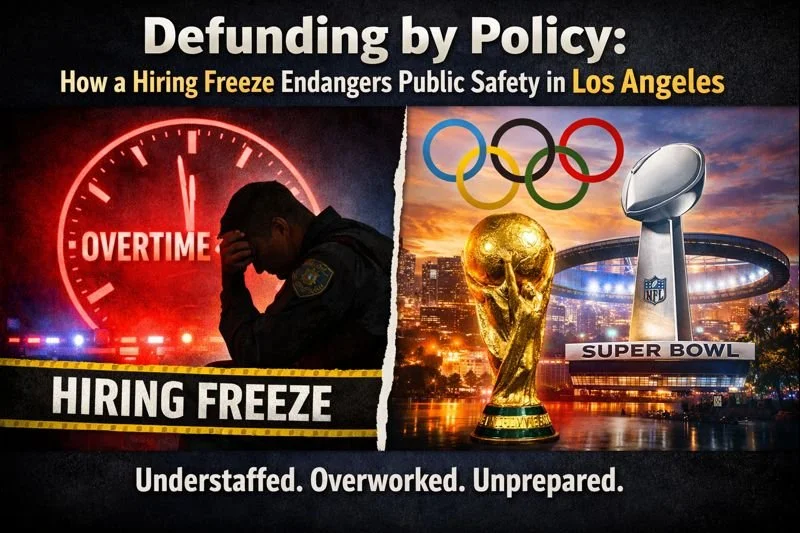
Los Angeles is preparing to host three of the largest global events in modern history: the FIFA World Cup, the Super Bowl, and the 2028 Summer Olympics. Tens of millions of visitors will arrive. Global media attention will be relentless. The expectations placed on public safety will be unforgiving.
At the very moment Los Angeles should be strengthening its public-safety infrastructure, County leadership is moving in the opposite direction.
Today, on February 3, 2026, the Los Angeles County Board of Supervisors’ plan to vote on a hiring freeze—one that would further restrict staffing at the Los Angeles County Sheriff’s Department—is not a neutral budgetary decision. It is a policy choice with predictable consequences. And under current conditions, it amounts to defunding law enforcement in practice, regardless of how it is labeled.
Los Angeles Has Already Crossed the Staffing Red Line
Both the Los Angeles Police Department and LASD are operating below safe functional staffing levels. LASD, in particular, is carrying thousands of vacant deputy positions, compounded by injuries, leave of absence, and restricted-duty assignments caused by on-duty injuries to personnel that routinely sideline a substantial portion of its deployable workforce.
This is not an abstract personnel issue. It is an operational crisis.
To compensate, LASD relies on force-mandated overtime at historic levels. Deputies are routinely required to work eight to twelve additional eight-hour shifts per month, not to surge for emergencies, but simply to keep patrol cars staffed and jail facilities functioning.
This is no longer surge capacity. It is a system held together by exhaustion. A hiring freeze imposed under these conditions does not pause growth. It locks in failure while attrition continues.
Why a Hiring Freeze Is Defunding by Another Name
Words matter, but outcomes matter more.
Although a safety exception may exist, a hiring freeze on an already understaffed sheriff’s department—while calls for service, jail populations, and special-event demands remain constant or increase—is functionally indistinguishable from defunding. The outcome is the same:
· Fewer deputies on patrol.
· Greater reliance on mandatory overtime.
· Higher injury and burnout rates.
· Accelerated resignations and early retirements.
· Slower response times and diminished proactive policing.
Workforce research consistently shows that mandatory overtime is one of the strongest predictors of attrition in law enforcement. When deputies are told that relief is not coming and promotions will be few—because hiring is frozen—the rational response is to leave as soon as contractually possible.
The County’s position effectively says: Do more, with less, for longer—and expect no reinforcements.
That is not fiscal responsibility. It is institutional neglect.
The Long Tail of 2020 Still Shapes Today’s Crisis
The staffing collapse did not emerge overnight. It is the cumulative result of policy decisions made in the shadow of 2020.
Following the death of George Floyd, policing became the focal point of national anger, political pressure, and ideological experimentation. Even jurisdictions that avoided explicit defunding votes absorbed the consequences: slowed hiring, shrinking applicant pools, early retirements, and deep uncertainty about institutional support. Los Angeles was no exception.
What followed was not reform grounded in capacity building, but policy hesitation—budgets debated annually, labor agreements delayed, and now an explicit proposal to freeze hiring despite clear evidence of operational strain. Each step sent the same message to the workforce: You are not supported, and relief is not coming.
The proposed hiring freeze simply formalizes that message.
Pay Compression, Forced Overtime, and the 2026 Exit Window
From 2020 through 2024, inflation eroded real wages across California. Housing, fuel, food, and insurance costs surged. Yet many sworn personnel received no meaningful inflation-adjusted pay increases, effectively absorbing years of real-term pay cuts.
At the same time, workloads intensified dramatically. This combination—declining real pay paired with escalating mandatory overtime—produces a predictable outcome: mass attrition.
Many LASD employees are positioned to retire or lateral in early 2026, when contractual milestones are reached. A hiring freeze ensures those departures will not be offset. The result will be a sudden loss of institutional experience at precisely the moment Los Angeles requires maximum operational capacity.
This is not a budget problem. It is a planning failure with a timestamp.
Mega-Events Multiply Risk, Not Capacity
The World Cup, Super Bowl, and Olympics fundamentally alter Los Angeles’s public-safety risk profile.
These events require sustained surge capacity, layered security perimeters, rapid-response units, intelligence coordination, and redundancy across agencies. They do not tolerate staffing gaps, fatigue-driven errors, or hollowed-out institutions.
Federal resources can supplement local law enforcement, but they cannot replace it. The foundation of event security is local deputies and officers who understand the terrain, the communities, and the threat environment.
A county that enters this period understaffed, exhausted, and hemorrhaging experience is not prepared—it is exposed.
When Policy Codifies the Muzzling Effect
In The Muzzling of the Sheepdog, I documented how policy, politics, and media scrutiny suppress proactive policing by creating organizational fear and disengagement. A hiring freeze under current conditions does something worse: it codifies the muzzling effect into policy.
When deputies see leadership knowingly restrict staffing while mandating overtime, confidence erodes. Initiative declines. Risk avoidance replaces engagement. The institution shifts from problem-solving to survival mode.
This is not ideological resistance. It is human behavior.
Mega-events demand decisiveness, initiative, and proactive policing. A muzzled, exhausted workforce cannot deliver that standard.
What Actually Works—and What Does Not
Recruitment slogans will not fix this. Task forces will not fix this. Delayed votes will not fix this.
The only interventions proven to stabilize law-enforcement staffing are:
· Competitive, inflation-adjusted pay.
· Retention bonuses for experienced personnel.
· Signing incentives for qualified recruits.
· Predictable schedules made possible through adequate staffing.
A hiring freeze does the opposite of all four.
If County leadership is serious about public safety, the hiring freeze must be abandoned immediately and replaced with a workforce-stabilization strategy grounded in labor-market reality.
This Is the Decision That Will Be Remembered
Los Angeles County is making a choice. It can acknowledge reality, invest in staffing, and prepare responsibly for the world’s arrival—or it can continue down a path of symbolic restraint that produces real harm.
A hiring freeze on an understaffed sheriff’s department is not neutral. It is not cautious. It is defunding in practice, and it will cost far more—in safety, money, and credibility—than it saves.
When the world comes to Los Angeles, there will be no asterisks, no footnotes, and no excuses.
Preparation is the only neutral position. And time is running out.