

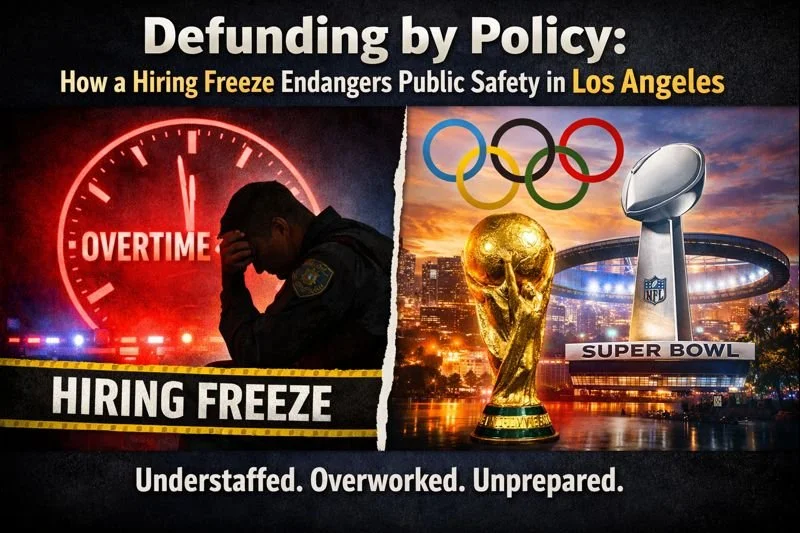


Los Angeles County is approaching a defining moment in public safety—not because of a single incident, policy, or personality, but because of the cumulative effect of decisions made over the past several years. The upcoming sheriff’s race is being framed as a choice between leadership styles and personalities. In reality, it is something far more consequential: A referendum on whether the policies shaping law enforcement in Los Angeles are producing the outcomes the public was promised.
The Reality Behind the Narrative
For years, the dominant narrative surrounding policing in Los Angeles has focused on reform, oversight, and accountability. Those goals are not only legitimate—they are necessary. But public policy cannot be judged by intent alone. It must be judged by outcomes. And the outcomes in Los Angeles County are increasingly difficult to ignore. Across the Los Angeles County Sheriff’s Department and the Los Angeles Police Department, agencies are operating under sustained strain marked by:
Persistent staffing shortages
Recruitment and retention challenges
Increased reliance on force-mandated overtime
A workforce operating under chronic fatigue
Increased liability claims
This is not a temporary fluctuation. It is a structural condition.
A Workforce Carrying the System
To maintain basic service levels, deputies and officers are routinely working eight to twelve additional shifts per month, often involuntarily. This level of overtime is not a sign of flexibility—it is a sign of imbalance. Decades of research across policing and other high-risk professions show that fatigue:
Slows reaction time
Degrades situational awareness
Impairs decision-making under pressure
In law enforcement, those effects translate directly into public-facing outcomes:
Slower response times
Reduced proactive policing
Increased likelihood of errors in high-risk encounters
This is not theoretical. It is operational reality.
Policy Didn’t Just Change Structure — It Changed Behavior
The current conditions did not emerge in isolation. They were shaped by a broader policy environment that, particularly after 2020, reframed proactive policing as a potential liability rather than a core public-safety function. Legislative proposals, political messaging, and sustained scrutiny collectively altered how officers assess risk—not only on the street, but within their own organizations. When officers perceive that lawful proactive behavior carries elevated institutional or professional risk, they reduce that behavior. Productivity declines. Engagement narrows. Policing becomes reactive rather than preventative. This is not resistance. It is adaptation.
Deputy Gang Allegations: What Was Claimed—and What Followed
Allegations of deputy subgroups within LASD—often described as “deputy gangs”—have been documented and debated for decades. What has changed in recent years is not simply the presence of those allegations, but how they were elevated within the policy and political environment. Coverage from outlets including the New York Post and others has raised concerns that these allegations were amplified in ways that shaped public perception, justified expanded oversight, and influenced leadership outcomes. At the same time, other investigations and reporting have treated the issue as a legitimate concern requiring continued scrutiny. Both perspectives exist. But the more important question for Los Angeles County today is not only what was alleged. It is what resulted.
Oversight Expanded. Outcomes Did Not Improve.
Los Angeles County significantly expanded oversight through the Office of Inspector General and the Civilian Oversight Commission. The stated objective was to improve accountability, transparency, and public trust. That objective remains important. But outcomes must be evaluated honestly. Since these expansions:
Staffing shortages have persisted or worsened
Overtime demands have increased
Recruitment has not kept pace with attrition
Operational strain has intensified
This does not mean oversight is unnecessary. It raises a more difficult and more important question: Has oversight been implemented in a way that strengthens the system—or one that has unintentionally weakened its operational capacity?
The Role of the Board of Supervisors
The Los Angeles County Board of Supervisors is central to this discussion. Through budget decisions, policy direction, and oversight authority, the Board shapes the operational environment in which law enforcement functions. A consistent argument has been that stronger alignment between the Sheriff and the Board would lead to improved public-safety outcomes. That argument is no longer theoretical. Despite alignment:
Workforce challenges remain acute
Overtime reliance continues
Operational strain has not eased
This is not a question of intent. It is a question of measurable results.
The Human Cost of Policy Decisions
Behind every policy decision are the individuals expected to carry it out.
Fatigue accumulates.
Morale responds to conditions.
Retention follows incentives.
When experienced deputies and officers leave, they take institutional knowledge with them. When staffing declines, remaining personnel absorb the workload. When fatigue increases, risk follows. This is not political. It is operational.
The Stakes of the Sheriff’s Race
The upcoming sheriff’s election is not simply about leadership. It is about direction. Voters are being asked—implicitly or explicitly—to decide:
Whether current policy trajectories are sustainable
Whether staffing and operational capacity are being prioritized
Whether reform has been balanced with effectiveness
These are not abstract questions. They shape how quickly help arrives, how effectively crime is prevented, and how safely communities are served.
A Path Forward Rooted in Reality
My research, published in the “Muzzling of the Sheepdog” study, did not argue against reform. It argued for balance. A functional public-safety system requires:
Accountability mechanisms that are clear, consistent, and measured
Policies that do not unintentionally suppress lawful proactive policing
Staffing levels that reduce reliance on chronic overtime
Leadership aligned with operational realities—not just political expectations
These are not competing priorities. They are interconnected.
The Bottom Line
Los Angeles County is not deciding whether to reform policing. That has already occurred. The question now is whether those reforms have been implemented in a way that preserves the system’s ability to function effectively. Right now, the indicators point to a system under strain:
Fewer officers
More overtime
Greater fatigue
Reduced proactive capacity
That is not a sustainable model for public safety.
Final Thought
Narratives shape policy. Policy shapes behavior. Behavior shapes outcomes. The outcomes are now visible. The question for Los Angeles voters is whether they are willing to evaluate them clearly—and act accordingly.